Homilies

Last Judgment Based On Compassion” (Given on the Solemnity of Christ the King)

Christ The King of Compassion.jpg

Last Judgment Based on Compassion

Our Gospel reading deals with the last judgment, when all people will be examined by the kinds of lives they have lived.

We tend to think people will be judged by whether or not they are righteous or religious, or by what religion they happen to be. Jesus indicates that judgment would be on the basis of our relationships. Jesus makes it clear that we will be judged by whether or not we are compassionate.

The king will say to those on his right,

For I was hungry and you gave me food,

Then, the righteous will answer him and say,

'Lord, when did we see you hungry and feed you,

Which means, the people on the right cannot even remember doing any of those things. It was a natural thing for them to do - which means they did them humbly. Those deeds were not done to gain any reward or to achieve any recognition. These people had acted simply out of a sense of compassion for their fellow human beings. It could mean also mean that the deeds were so simple…. No big deal – in human eyes. A hungry person was given a meal. A stranger was treated hospitably. A sick person was comforted by a visit, a pat on the shoulder, and perhaps a prayer. All of these things are so small. But to Jesus, they were the ultimate test of life.

Compassion is not really a simple matter. A man who writes a large check for charity, but still treat his wife and children harshly cannot use his donation to compensate for his unkindness. We cannot pay for our sins with our money.

Compassion is not something that we occasionally do. It is what - which - we consistently are. Character is not revealed by our righteous deeds, but by our inner motives. People see our actions. God sees our intentions. A truly kind person will be kind… to his family, to his neighbors, to a stranger, to a dog, even to his enemy. Jesus talked about the inwardness of character. Jesus said: “A good person, out of the store of goodness in his own heart, produces good.”

When the Son of Man comes, he will sit on his royal throne. On that day, one question will be asked: “Did you care, did you really care?” On that day - we will be measured by one standard – compassion. According to Jesus, that is the ultimate test of life – compassion.

Now, let me ask you a question: Where do you see yourself in the story? What person or group of persons do you most identify with? Do you belong with those on the right who help or those on the left who do not help?

If you really think about it - Most of us would have difficulty completely identifying with either group, and yet we probably feel some kinship with both. There have been times when we helped – we have given to charity, to the Church, to the poor, visited the sick in the hospital and more.

But we have to admit that there have been times when we turned our backs and walked away. We have seen someone who needed our help and somehow have excused ourselves from giving that help.

Thus – the real truth is that we cannot totally identify with either group. We sort of have one foot in each camp. All of us are a little of both.

So – where does that leave us? What is Jesus really telling us?

Actually, there were not only two groups of people in the story, there were three. There were the people who helped, and there were the people who refused to help, and the third group were the people who needed help which is the group we have been overlooking and these are the people with whom Jesus chose to identify Himself. He said that to help them was to help him, and to neglect them was to neglect Him.

The true meaning of compassion is contained in that powerful sentence: “As often as you did it for one of my least brothers (and sisters), you did it for me.” Jesus so completely identified with people in need that their pain was his pain. And any kindness done to them was kindness done to him.

Like Jesus, we are to put ourselves in the place of those who are the weakest and most vulnerable. We are to walk in their shoes, so to speak. We are to try to feel what they are feeling.

The Latin root word for compassion is pati, which means to suffer, and the prefix com- means with. So, compassion, originating from compati, literally means - to suffer with – which is much different from just helping people who are suffering.

… And that connection with another person who is suffering brings compassion beyond sympathy into the realm of empathy.

Admittedly, that will be a very difficult thing to do, but with God it is possible - because most of us have never been there. Just think of the people in the Philippines who are suffering because their homes were recently destroyed by super- typhoons and floods in the midst of the pandemic with no means of supporting themselves and they have lost everything even the little they have and even lost their loved ones. You probably know many more stories of people suffering and struggling even here in our society because of this pandemic.

Maybe - some of us can relate but most of us have not known what it is like to weep with no one to hear, to want with no one to care, to need with no one to help. But Jesus knew what that was like. He never forgot it, and he will not let us forget it either.

Jesus took his stand with the needy people of this world and said in effect: “This is where I live. These are my people. I belong to them, and they belong to me.” Do you see the significance of that? Jesus not only cared about the needy and sought to help the needy– but Jesus completely identified himself with the needy. For Jesus, they were not only another group, separate and apart. They were his brothers and sisters. Their hunger was his hunger. Their loneliness was his loneliness. Their need was his need. He himself belonged to the fellowship of the needy.

And let’s face it, that’s where you and I belong as well. It is not as if the needy people of this world were another group over there somewhere. It is not as if they are the people who need help, and we are the people who give help. Not that at all. We are all linked together; we are all members of the same family. We all belong to the fellowship of the needy.

None of us is self-sufficient. We need each other, whether we admit it or not. Meaning – those who help, even those who refuse to help and those who need help are all linked together.

So - Who are the needy? I am; you are; everyone is. Today I may help you, but tomorrow, I may need you to help me. We are all members of the same family, sharing our love, sharing our resources, sharing our needs… and that is the kinship of all humanity – of all creation.

We are all brothers and sisters of Christ our King, sons and daughters of one loving gracious merciful Father.

And I close with this – From the opening statement of the Pastoral Constitution on the Church in the Modern World– Gaudium Et Spes – Promulgated by St. Pope Paul VI.

You see – We are the Church in the world. We are the People of God. We are the Body of Christ.

“The joys and the hopes, the griefs and the anxieties of the men of this age, especially those who are poor or in any way afflicted, these are the joys and hopes, the griefs and anxieties of the followers of Christ.”

And so, are they yours, too? Do you really care? At the end of our lives, we will be judged based on our compassion, our self-giving love.

God bless…

Make Gaining Wisdom A Priority

If any of you lack wisdom.jpeg

Reflection on “Make Gaining Wisdom A Priority” based on the Gospel of Matthew 25:1-13 and Wisdom 6:12-16 (32nd Sunday in Ordinary Time):

If you could be granted your biggest wishes, what would they be? Would you ask for wealth, or long life, or good health? Would you ask for blessings for your children, or for happiness, or for world peace? Of course, all of these are noble and wonderful wishes.

But what if you were given only one wish. Just one. What would it be?

From the Book of Kings: One night, God appeared to Solomon in a dream and gave the young king the chance to ask for any wish he wanted, but only one wish (1 Kings 3:5). Wealth, pleasure, health, power—all of these must have occurred to Solomon. But he asked for none of these, important as they were. Solomon asked only for wisdom.

And so, along with wisdom, God granted also wealth and health and power and children and fame to Solomon. It was wisdom that allowed Solomon to handle all of these other gifts with grace. In other words, without wisdom, you will not know how to handle your wealth and health and power accordingly… and you will still be miserable.

We pray to stay healthy especially in this pandemic and to have a long life…. The question is - if God were to give you a long healthy and prosperous life – what will you do with your life?

Most people think of Jesus’ teachings in terms of moral and ethical values – things are either good or bad – right or wrong – about goodness, righteousness and love. That’s true but Jesus taught something equally as important, and that is wisdom. Jesus wants people to be good – that is obvious, but he also wants people to be wise.

Wisdom is more than cleverness, or book-learning. It is about deep understanding, discerning. Wisdom is basically seeing ourselves, others, seeing our current circumstances, seeing reality as God sees them – from God’s perspective.

An American tourist visited a Polish Rabbi, who was looked upon by the people of his time as a sage and saintly person. On his arrival at the rabbi's residence, the tourist was astonished to discover that it was only one simple room. The walls were lined with books; a table and a chair were the only furnishings. "But rabbi," the tourist asked, "Where is your furniture?" To which the rabbi replied, "How about you, where is yours?" "Where is mine?" said the puzzled tourist, "I'm only a tourist here. I am just passing through." "So am I" answered the Rabbi, "so am I."

Living wisely means "staying awake", so to speak. Living wisely means looking ahead. Living wisely means acknowledging that we are only "tourists" on God's earth, that we are only "passing through." Living wisely means pointing oneself in the direction of the very Source of life. Living wisely means acknowledging one's dependence on God not only for life but also for the way of life. Living wisely means developing a lifestyle of faith in God's promise of ultimate, total fulfillment -- when the "tourist" season of life is over.

And so, as we draw close to the end of the liturgical year, the church, through the gospel, invites us to contemplate the end – the end of our lives and the end of the world. The way to prepare for the end is not to live in fear and anxiety, or to go after prophets and visionaries who claim to know how and when the world will end.

How and when that will be, only God knows. How then are we to prepare for the end-times? Today’s parable gives us the answer: The best way to prepare for the end is to follow the example of the wise virgins. The wise virgins took enough oil to keep their lamps burning. In the same way we should continue to engage and persevere in prayers and good works, the oil of our faith, to keep our faith alive. That is the best way to make ourselves ready and prepared for the Lord, no matter how and when the Lord chooses to come.

Admittedly, life is full of surprises. Most of us know that, and those who don’t will surely learn it. Some of life’s surprises are pleasant and some of them are painful, to say the least. We would prefer the pleasant. They are so much more fun, so much easier to handle. But we had better prepare for the painful surprises, because some of them are sure to come.

Some of you might be thinking, “Isn’t that a bit morbid?” No, it is only sensible. Life is not made up entirely only of happy events. Life also includes some challenges, some emergencies. If you and I are wise, we will make preparation for such occasions before they come.


How are we to do that? Build spiritual reserves now. Learn to pray daily, learn to get in touch with God and draw upon His power. Listen to God daily. The time is sure to come when our own human strength will not be enough to last us through the night. If we know that, then we should get ready for it now. That is just common sense.

Time and time again, Jesus appeals to us not only to be good, but to be wise. This is the emphasis of today’s Gospel reading. How do we become wise? OR How do we find wisdom? It is found in God Himself. From the letter of St. James, “Does any of you lack wisdom? Let him seek it from God, who gives it liberally to all who ask.” (James 1:5).

As we heard in the first reading from the Book of Wisdom:

“She is readily perceived by those who love her,
and found by those who seek her.”

Meaning - we must decide to pursue wisdom intentionally. We must make gaining wisdom our priority. Wisdom does not just come naturally as we go through life. There are people in their 60’s 70’s and even 80’s who still don’t get it. Have you noticed that some people keep repeating the same mistakes, as if they are not paying attention to life at all, not heeding its lessons? Just living will not automatically impart wisdom. In fact, wisdom is not even just learned by life’s struggles, “school of hard knocks” so to speak, though that is certainly one of her classrooms.

Wisdom can be gained by learning from our good and poor decisions, and those of others.

Wisdom is not the same as intelligence nor talent. Wisdom is not just knowing how to speak cleverly. It is not the same as being knowledgeable. Wisdom is knowing what to do with what you know. Wisdom is knowing what to do with what you have, be it much or little. Wisdom is knowing what to say, or when to remain silent.

It is also possible to gain wisdom by observing the lives of others.

We can be inspired by the example of another person including the saints we have devotion to.

But – this is very important to keep this in mind - the really important things in life are non-transferrable… regardless of how you are to that person.

The parable of the ten virgins from our Gospel reading - Some people have criticized this parable as a picture of selfishness because the five who had oil would not share with the five who had not. But that is missing the point of the story. Jesus was not talking about lamps and oil. He was talking about people and life. And the plain truth is that there are some things in this life that cannot be transferred from one person to another, regardless of how much you desire to do it.

Think of a gifted artist in the later years of life and think how wonderful it would be if he could transfer that genius to the mind and the hands of a younger person. And yet we know that can never happen. The only way a younger person can ever have that genius is to find it and build it for himself.

That is how it is with all of life.

This is what Jesus is saying. Faith, hope, courage are intensely personal virtues. When the crisis comes in our lives, you do not have the time any more to go and get them, and there is no way to borrow them from someone else. So, you had better build them on your own, store up some spiritual reserves, and carry them with you along the way of life – so you will be ready however, whenever the Son of Man will come.

God bless…

32nd SUNDAY IN ORDINARY TIME—CYCLE A

November 7/8, 2020

The Text: Matthew 25:1-13; Wisdom 6:12-16

Trust God Do Not Be Anxious”

Trusting God and Do Not Be Anxious.jpg

At every Mass – After we pray the Our Father, the priest prays: “Deliver us, Lord, we pray, from every evil, graciously grant us peace in our days, that, by the help of your mercy, we may be always free from sin and safe from all distress, as we await the blessed hope and the coming of our Savior, Jesus Christ.”

We pray to be safe from all distress or anxiety because we live in a world where many people are anxious and stressed… To say to people – “Do not to be anxious.” - admittedly – is much easier said than done.

We are bombarded with experiences and news about violence, environmental disasters of one form or another, COVID19 and new kinds of viruses and illnesses, etc. There seems to be much to be worried about.

In the Gospels - anxiety is presented as lack of faith…  So - to pray for protection from anxiety, to pray to have no anxiety - means to pray for an increase in faith. 

To say we have faith in Christ – means - that we truly believe Jesus is Lord, and that He rules over all and He comes in triumph to banish all that is evil. So - when confronted with fears and dangers, the Christian response is a response of faith – not running away from problems and challenges – but he faces them - precisely because in Christ - they must be overcome.

There is a saying: “If you pray, why worry? If you worry, why pray?

Jesus said to His disciples: “I have told you this so that you might have peace in me. In this world you will have trouble, but take courage, I have conquered the world." (John 16:33)

Our faith or lack of faith affects how we face the problems of life. People who have no faith or who lack faith usually respond to life's problems with worry and even anxiety. People of faith respond to life's problems with prayer. In prayer, we raise our hands to our all-loving and all-powerful Father, who is able to save us, even if it should take a miracle to do so.

And that is why, as believers, “we await the blessed hope” - because our faith tells us that Christ DOES overcome all that threaten us. That is why we respond: “For the kingdom, the power and the glory are yours, now and for ever.”

With that faith – we find ourselves even grateful.

As we heard in the second reading from St. Paul’s letter: “Have no anxiety at all, but in everything, by prayer and petition, with thanksgiving, make your requests known to God.” 
 – Being grateful in all circumstances is an acknowledgement that God is in control and therefore we become more confident, for we know that God is still going to care for us… even when times are tough… even when circumstances are sodiscouraging – with grateful heart instead of fearful heart.

That is why and how St. Paul can write this letter of encouragement to the Philippians even while he was in prison. 

In our Gospel reading, the message is pretty much the same.

What does Jesus' parable tell us about God?  It tells us of God's providence and generosity.  The vineyard is well equipped with everything the tenants need.  The owner went away and left the vineyard in the hands of the tenants… meaning…  God, trusts us, the tenants, enough to give us freedom to live our lives as we choose. 

This parable also tells us of God's patience and justice.  Not once, but many times he forgives the tenants for their abuses and violence.  But while the tenants take advantage of the owner's patience, the parable tells us also that - in the end - God’s judgment and justice prevail.

What does the parable tell us about us?  We are stewards of God’s creation – what a privilege to be thankful for!

But the problem is our wrongful attitude… which is the cause of our anxiety – the problem is in how we see ourselves - forgetting who we are – forgetting that we are only tenants, we are not the owners; forgetting that we are not in control and forgetting and not trusting in the love and care and power of God.

One especially critical question – we need to ask ourselves - Do we see ourselves as “owners” or “tenants” in the world... which makes a whole world of difference.

For some strange reason we live our lives as if these earthly possessions are ours forever.  We devote our time and energy to accumulate and protect worldly things. We cling to the things of this world as if they are ours forever.

The parable in today’s Gospel is a great reminder - First, that we are only tenant farmers and we just share in the fruit of the land.  Not one thing in this vineyard really belongs to us.  Everything that we see around us is ours only to use for a short time.   Ultimately - it all belongs to God.

If we fail to recognize this truth, we are not fooling anyone but only ourselves.

Secondly, Jesus is reminding us that our privilege of being stewards of creation carries with it responsibilities.  We are responsible to God for what we do with what we have… be it much or be it little.

The word responsibility is not a very popular word in our modern world.  We much prefer to think and speak of such things as rights, and privileges and freedom – “my body and therefore my choice – I can do whatever I want with my body.”  But we must remind ourselves that all of these things we cherish are based upon responsibility, and if we neglect our responsibility, eventually we will lose our rights, privileges, and freedoms… That is the bottom line… let us not fool ourselves.

St. Francis of Assissi, whose Feast Day we also celebrate today, realized that humanity’s relationship with the rest of creation goes even beyond dominion, even beyond stewardship but in terms of “kinship” with the rest of creation. That’s why he used words such as Brother Sun, Sister Moon and even Sister Death and Mother Earth to care for and to love.

We have every opportunity to live life at its best.  What we do with these blessings and opportunities is up to us.  The grace of God is free, but the responsibilities of privilege are real.  We are accountable for the things that we have.

We are the tenants even to our bodies, to our lives, to ourselves, to our money, to our property, to everything we have.  All belongs to God.

We – Christians – the New Tenants, so to speak - are called to give God the produce at the proper times…

Therefore, we must have a personal relationship with Christ to be good tenants – and we must build everything – our lives, our career, our families, etc. - on Christ and that Christ thus becomes the cornerstone on which everything else is built…because everything belongs to Christ. 

The question is - Is Jesus Christ the cornerstone of your life?

If He is, then the Good News is – as St. Paul wrote to the Philippians and addressed also to us: “The peace of God that surpasses all understanding will guard your hearts and minds in Christ Jesus.”

… and if we say Amen, it means “So be it” – and so we all say: Amen!

God’s Generosity and Invitation to Love

parable-of-the-workers-in-the-vineyard_dvd.original.jpg

Reflection on “God’s Generosity and Invitation to Love” based on the Gospel of Matthew 20:1-16 (25th Sunday in Ordinary Time):

In the kingdom of God, there is family, community – not just as a society or group of individuals.  In a society – there is this “we-and-them”, there is rivalry - survival of the fittest.  But, in a family, there is only “all - we – us” - and NO them. There is the spirit of co-operation rather than competition.  

In the Gospel parable, the workers in the vineyard complained because they saw each other not as family members but as rivals, as competitors.  If the latecomers in the vineyard were seen as family members of the early workers, the early workers would have rejoiced with them at their good fortune rather than grumbling.  There is one popular “oldies” song that goes: “He ain’t heavy, he’s my brother.”

We need to expand our concept of family beyond our blood relatives - because we are all members of the same Body of Christ, of one Spirit, with one heavenly Father… who is so generous … who sees all of us as His sons and daughters… and so we are brothers and sisters.

You see - The Gospel parable is really about God’s generosity, His grace, His goodness and mercy and His invitation to us into a more intimate relationship and not so much about fairness- but about relationship.

The problem is we often get caught up on issues of fairness – comparing ourselves with others, with one another.

We often feel discontented - because we often compare our lives with those who are doing better, with those who have more.  You see - there will always be someone richer, healthier, more talented, or better looking than we are.….

So, when it seems life is unfair - we need to take a fresh look at the good things in our lives – the things we often take for granted.  When we “feel cheated in life”, let us just think of those with less – the less fortunate - and not those with more.

The workers in the parable did not feel they were mistreated when they were hired - first.  It is only when the owner extended his generosity to the workers hired late in the day.  You see - We usually do not have problems with people’s generosity, with God’s generosity to us - when we are the ones receiving it – when others are envious of us - because we feel special.

In a way – it is like - when we come before God for our sins, we ask for Mercy but when it comes to other people’s sins or faults particularly against us, we demand justice.

All of us are like the workers in the parable who were hired later in the day… and so, we can say that we are all “latecomers.” 

If we want to compare ourselves with others – let us compare ourselves with the saints who are as ordinary people as we are. Compared to the saints who served God faithfully and who gave up their lives for the sake of the Gospel, serving others - St. Paul, St. Teresa of Avila, St. Teresa of Calcutta, St. Francis of Assissi, countless martyrs and saints, how do you think we are - compared to them?  - But God is equally generous and compassionate with the saints as He is with us.  He loves us, offers us His divine life – No Less… Everything is by the grace of God.

So, when we feel cheated in life, treated unfairly; when it seems life is so unfair – when bad things happen even to good people and the bad people seem to be the ones enjoying life and the ones prospering – we need to continue to trust God – his goodness, that He is just…that He is in control….even when things do not make any sense and even when we cannot understand.

In the grand scheme of things, we can see only a very tiny portion of the big picture… of God’s plan… 

We need to be in a relationship of love and trust with our God instead of on the basis of what is in it for me.

Here’s the big question for all of us:  Why do we follow Jesus, why do we obey his teachings? Why do we obey the Ten Commandments? Why are we here – why do we come to Mass?

– Is it because we want to go to heaven – and because we are afraid to go to hell?

Do we follow Jesus so He will bless us? … so that he'll make our family happy? So that bad things will not happen to us?  Do we pray the rosary or the novenas or go to pilgrimages or first Fridays or First Saturdays because of the promises - that no misfortune will come to us… that we will receive all the “indulgences”.

I am not saying those are bad motivations.  But we need to go beyond those motives.  Because – in a way we can say – with all due respect – those motives are the same as saying: “What is in it for me, Lord, if I do all those things?

When we go to confession – one of the versions of the Act of Contrition – we say: “I detest all my sins because I fear the loss of heaven and the pains of hell – (and here’s the most important part) - but most of all - because I offended thee my God who are all good and deserving of all my love…”… out of love…relationship of love….We cannot earn our way to heaven. Again, everything is grace.

All of the parables that Jesus told - always have - as the core purpose - to teach us something about our relationship with God. 

From this perspective - we can understand Paul’s letter to Philippians (1:21) – we heard from our second reading. Paul is not focusing on himself but on his relationship with Christ – with God.

Basically - St. Paul was saying: "For me life means Christ. Even if I die, it doesn't matter.  If I live – thanks be to God! - there' so much more I want to give. If I die - thanks be to God! – that means I will be with God!  If I live, I can continue to bring others to God. I am not going to live for what I can get out of life.”

That is how he found contentment in whatever circumstances he found himself in – even in prison… where he wrote this letter of encouragement.

… And so – for us - What happens now if after doing all our devotions – God forbid – what if bad things would happen to us? – What happens when we feel cheated by life?  Unfortunately, that is when people lose faith.  They no longer see God as good but unfair.  God does not seem to be real anymore.

Salvation is really when following Christ is no longer about us – no longer about ME, MY, OURS…  Salvation is about Jesus and our love for our neighbor and the life that we give – the life that we share… Jesus said:  “For whoever wishes to save his life will lose it; but whoever loses his life for My sake (for the sake of the Gospel) will find it.”  (Matthew 16:25)

So, my brothers and sisters in Christ, let us examine our reasons why we do what we do, why we follow Christ.  Let us be honest with ourselves.  Let us continue to pray for the Lord to purify our intentions, to increase our love for God and our neighbor….

…Let us pray that we may serve God and our neighbors - with joyful, grateful and generous hearts, not looking for how much we can get - but rather looking for how much we can give, how deep we can love.

At the end of our lives, that is all we can take with us – how much we have given of ourselves – how much we have loved, what we carry in our hearts.

(Homily for 25th Sunday of Ordinary Time Cycle A 
Readings: Isaiah 55:6-9 Philippian 1:20-24,27 Matthew 20:1-16)

Loving and Forgiving Instead of Judging

if-you-judge-people-you-have-no-time-to-love.jpg

Generally - When someone hurts us, we immediately draw a vision or image of that person. You kind of paint a picture in your mind of the kind of person he or she is….you kind of judge the person based on what you think in terms of the hurt – “she is mean, he’s so arrogant, insensitive, heartless, etc.” and when you talk to other people, they might even add to your growing prejudice…. So, if you were to draw a picture, you might even draw a monster, even with horns, etc.

But - Remember, your perception or what you think is not always reality.  We react to what we think which – maybe - is not the reality… meaning, there is a possibility that you could be wrong or that you could have misunderstood and therefore you could have been quick to judge.

Assuming you were right to feel offended, the only way to heal ourselves of those hurts is through forgiveness. It is not enough to be right, and yet you are so unloving, unforgiving.

Forgiving begins when we give up the horrible image we have in our mind of that person who hurt us. Meaning - We must come to a new vision of that person, not simply as the person who hurt us, but as a weak and sinful faulty person who also has needs and hurts, and so we try to understand what caused him or her to behave in that way or to say such a thing or why he failed to do what you expected.

At the cross, Jesus said: “Father, forgive them for they know not what they do.” …meaning – why would you condemn someone who does not know any better…

You might say: “But he is already an adult, he should know better”… but you see – there are people –even adults in their 60’s 70’s and 80’s - who still don’t get it. 

You see - the problem is: when we come before God for our sins, we ask for Mercy but when it comes to other people’s sins or faults particularly against us, we demand justice.

Again - Forgiving begins when we give up the horrible image we have in our mind of that person who hurt us and coming up with a new image. And so - With that new image - Consequently, there is a new feeling towards the person. The new vision brings a new feeling because now you see this person more realistically.

And then – the next stage, so to speak is - there must be a surrendering of the right to get even. We simply give it up. Yes – you might think you have every right to get even as you might think, but we simply give it up or let it go.

An eye for an eye, a tooth for a tooth, results to both parties – ending up both being blind and toothless.

On our own, we cannot forgive but by the grace of God we can, and with the grace of God we can even go beyond giving up our right to get even, we can even begin to wish that person who hurt us well… which is really a miracle.

As has been said: “To err is human, to forgive is divine.” (Alexander Pope)

The process of forgiving is fulfilled when you can want good for the person who has wronged you instead of wishing evil to fall upon him or her… The good of the person then will be your intention for approaching that person, as we heard in our first reading and in our Gospel reading, to help the person grow and become a better person… not to get even.

Then you can say you fulfilled the commandment “Love your enemy”.. “Love your neighbor as you love yourself” because love – true love is willing the good of the other… even if the person is unloveable.

Jesus died for us even while we were still sinners.

St. Pope Gregory the Great whose Feast Day we celebrated last Thursday wrote this on Praying for Enemies and Forgiveness:

Quote: “How frequently we offer a prayer for our enemies but we do it because we are commanded to and not out of love for them.

The judge of our souls consider our hearts rather than our words.  Jesus included a condition in the prayer: Forgive us our trespasses as we forgive those who trespass against us.

Sometimes we say those words without carrying them out.  We must not allow any malice at all to remain in our own hearts.

Remember what Jesus taught us: Forgive and you will be forgiven.  Let us forgive others then - so that we, too may be forgiven.” (Unquote)

If you have been hurt - Do yourself a favor, forgive… to free yourself of the toxicity that can poison your soul. Of course, it is much easier said than done.

If the saints, who are as ordinary people as we are, can do it, by the grace of God, we can do it.

Judgment belongs to God.

If you cannot forgive, maybe you need to examine your own relationship with God and your own experience of forgiveness, of being forgiven.

As Thomas Merton said: “We are not at peace with others because we are not at peace with ourselves, and we are not at peace with ourselves because we are not at peace with God.

If you think about it: Who are we to cast off someone whom Jesus has seen fit to redeem? Who are we to condemn someone whom Jesus has died for? Jesus died for all of us… for people of all times.

Think of the person you have a hard time forgiving and imagine Jesus telling you: “I already paid for his or her sins.” and so, “Be Merciful”.

Forgiving someone falling short of our expectations does not mean glossing over sin, but it does mean always trying to treat people with the respect and honor they deserve as beloved children of God – as brothers and sisters who have great dignity in God's eyes.

Mercy is not about pretending that something has not happened, that sin doesn't matter. Mercy is about accepting to love as one is.

St. Mother Teresa said: “If you judge people, you have no time to love them.”

As we heard in the second reading from St. Paul’s letter to the Romans:

“Brothers and sisters:  Owe nothing to anyone, except to love one another”.

My brothers and sisters in Christ, over time – if we persevere – like the Saints – we can become more like Jesus. And that’s the challenge for us. And so the question is: Will we stand fast in our ways, our ways of thinking or will we let the Holy Spirit continue to mold us and to shape us?

The next time you find yourself ready to judge someone, ask yourself this, “How would Jesus react in this situation?” What is the most loving thing to do? … and then you “Pause” and let the Spirit give you His insight. You’ll be amazed by how much peace and wisdom He can give you!

God bless…

Homily for the 23rd Sunday of Ordinary Time Year A
Readings:Ezekiel 33:7-9 Romans 13:8-10 Matthew 18:15-20

God Provides Through Us

The-Provider.jpg

There is a profound liturgical action that takes place at the ordination of a deacon. After the bishop lays his hands on the candidate and says the prayer of ordination, and after the deacon is vested, the bishop hands the new deacon the Book of the Gospels and says, “Receive the Gospel of Christ, whose herald you now are.  Believe what you read, teach what you believe, and practice what you teach.”  “Believe what you read, teach what you believe, and practice what you teach.”  

Meaning - No one can proclaim the gospel unless he believes in the gospel and unless he lives these gospel beliefs.  This is fundamental to all Christians – the message is for all of us – not just for the clergies.

“Believe what you read” – meaning - believe the Gospel – but of course – first of all – we need to spend time reading the Scriptures through which God communicates to us in a personal way.  Second Vatican Council document put it this way: “In the Sacred Scriptures, the Father who is in heaven meets His children with great love and talks with them about His great love fulfilled in Christ.  In reading the Scriptures, we therefore encounter Christ who is the Way, the Truth and the Life.

“Believe what you read” - “Teach what you believe” - Everyone is called by Christ to proclaim His Gospel.  All of us are empowered for this mission.  We have the gifts of the Eucharist to sustain us.  We have the power of the Holy Spirit poured unto all of us at our baptism and confirmation.  We have the guidance of our Mother Mary…

“Teach what you believe” “Practice what you teach.” – Walk the Talk.

A father was giving a sermon to his teenage son.  The teenager replied: “What you are speaks so loudly I cannot hear what you are saying.”

Let us hope and pray that our children or anyone will not say or even think of saying that to us.

There is a phrase that goes, “You cannot give what you do not have.” It applies to all Christians.

When we live our lives in relationship and in communion with God, who gives of Himself to us, we become conformed to God’s grace and so we become channels or instruments of God’s grace and we ourselves become grace and when we in turn give what we receive, we find it multiplied beyond what we can imagine.  

We are all called to give ourselves in loving service of God and others as a continuation of Christ. The word Christ means Anointed and we were all Anointed at our baptism and confirmation – We are the Body of Christ.

In our Christian service, others must discover Christ in us because if we are not giving Christ to others – if we are filled with our ego and self-centeredness and our own agenda; if those whom we serve are not encountering Jesus in us, then our service is simply not true Christian service. It might be considered only as good charitable work, a philanthropy, it might be empathy; but it falls short of genuine Christian service if those whom we serve do not discover Christ – if they do not encounter Christ through us.

Like John the Baptist, we must decrease so that Jesus can increase in us, so that our brothers and sisters are not cheated out of encountering Christ whom they secretly long to discover in each of us.

We need to realize that the presence of the Lord is not ours to keep for ourselves and for our own benefit and salvation.  He is given to us so that we can bring His Love to others.

A lot of people nowadays, young and not so young are hungry and thirsty, so to speak, and have even lost sense of what life is all about.

The readings today help us recognize the gifts we have been given and the responsibility we have to give them to others.  From our first reading from the book of the Prophet Isaiah: “Come to the water, you who are thirsty.  Come eat - you who are hungry. “

The second reading, from St. Paul’s Letter to the Romans, tells us that no one and nothing can take the Source of Life from us. “What can separate us from the love of Christ? Anguish, or persecution, or nakedness, or famine or the sword or Covid19 pandemic?  NO.  Not even death.  Nothing can take Christ from us – But - We can reject Him. We are free to choose.

Our responsibility to stay united to the Lord has a deeper dimension than our own personal needs.   We need to be united to the Lord out of a responsibility to the spiritual lives of others – so we can bring Christ to them and them to Christ.

People think of Christianity only in terms of good works to be done or service to be rendered… but that is not all.  Yes - we are called to pick up our cross daily and follow Christ – which is not easy – to say the least… because to follow Christ requires our whole being.

But - as Christians - we are called to follow the highest ethic – the highest standard - that the world has ever heard… and, trying to do that in our own strength is like trying to feed five thousand people with fives loaves and two fish.  We cannot do that and so, the Gospel offers us help. 

We need to realize and experience the need of others.  We need to recognize our own limitations and emptiness, our inability to help.  And so - We need to go to the Lord, and He gives us the ability to provide. This is the Good News, the Gospel…for nothing can prevent us from being united to the One who provides for us.

How beautifully positive the readings are for today.  God will always provide. 

We have only to go to Him, stay united to Him, and we will receive bread for His people… meaning, we will receive blessings – the grace we need – not only for ourselves but for His people.

So – my brothers and sisters in Christ - Let us give Jesus whatever we have and He will multiply them for the good of others.

In Luke 4:16-20: Jesus came to Nazareth, where he had grown up, and went according to his custom into the synagogue on the sabbath day. He stood up to read and was handed a scroll of the prophet Isaiah. He unrolled the scroll and found the passage where it was written:

“The Spirit of the Lord is upon me,

because he has anointed me

to bring glad tidings to the poor.

He has sent me to proclaim liberty to captives

and recovery of sight to the blind,

to let the oppressed go free…”

Then Jesus said: “Today this scripture passage is fulfilled in your hearing.”

Meaning – And the Word became flesh.

That is a call for all of us as the Body of Christ.

St. Teresa of Avila said it so beautifully:  “Christ has no body now on earth but yours; yours are the eyes with which He looks with compassion on this world; yours are the feet with which He walks to do good; yours are the hands with which He blesses the world. Christ has no body now on earth but yours.”

Like Jesus, the Bread of Life; like the Eucharist, our lives must be blessed, broken and shared and poured out in loving service of God and others.

Amen.

Aug. 2, 2020

Eighteenth Sunday in Ordinary Time  -  Cycle A

Wheat and Weeds

wheat and weeds.jpeg

Homily on “Wheat and Weeds in Our Lives” based on the Gospel reading (Matthew 13: 24-43):

Like many of you, one of my favorite hobbies is gardening. In fact, I even have a worm compost bin and I use the worm castings to fertilize the plants and trees. 

I try my best to have a really nice garden.  But, I also accept the reality that my garden will never look as beautiful as what you can see in Gardens magazines and the ads.

That is the reality of life as well.  Jesus tells us also that we can expect weeds along with our good plants throughout our lives.  He tells his disciples that in this world the good will exist along with the evil and it is going to be that way to the end of time. That's life and we have to expect to deal with that reality. 

It is a fact of our society and a fact in our own personal lives.  All of us experience good and bad in ourselves.  We strive to be good, to do good and to live a life pleasing to God the best we can, but we all fail at times and we sin.  We all have weeds in the garden of our life.  So, what do we do about it?

Let us start with the bigger picture - Where our society is concerned, Jesus gives us the answer.  We have to be the yeast of our society.  It is our task as followers of Christ to be active in our society to eventually leaven the whole batch.  I know its easy to say, "What can one person do?"  But that is exactly it.  Change has to start with one person, with one act, with one idea. 

Let me tell you a true story – just recently

Overseas Filipina Worker in Dubai - Feby Dela Peña offers 200 free meals a day to Dubai’s hungry jobless migrants- hit hard by the Corona virus shutdown.

Febi, who is also unemployed herself, said: “We’re poor, to be honest, but it’s not a reason for me not to help.  She relies on her husband’s modest income from a sales job.

She was able to buy about $130 worth of groceries, including 30 frozen chickens and sacks of rice, to startwith…and she began to cook.

Like most migrant workers in Dubai, the family lives in a shared flat.  When her 11 housemates found out about her plan –– those who could - chipped in - as well. That is how Feby, age 34, launched the project she calls Ayuda – which means help. 

She said: “Life is so hard and people don’t have anyone to depend on,”

“It’s a big thing if you can help even 10 people not to sleep hungry,”

And when word of her efforts spread on social media, people began dropping off cartons of eggs and bags of rice. In fact, an influential Emirati blogger gave her 10,000 dirhams = about $2,700 US dollars.

Meaning - Feby’s single act grew and grew.  More and more people became involved in the work… like the mustard seed which starts very small and grows large.

It all happened because one woman had an idea and felt a need to help her fellow human beings who are in need. 

People, even believers ask: With all the troubles in the world, it seems God is not doing anything?  You see- God is doing something.

The question to you and me is this: What am I doing – what are you doing?  We have so many problems facing us today that may seem so overwhelming.  Where do we start?  What problem is most important?  What can we do?

We can all follow the example of Feby and start doing something, no matter how small… and we can start with our families.

There is this belief in our society that you can fix anything by throwing money at it.  That's not the answer here.  It takes personal involvement to be yeast.   That is what it takes.  We have to become personally involved in our world to make this world a better place.  To be true followers of Jesus, we have to pick up our own cross. 

Not everyone is not called to be a Mother Theresa or be like Feby.

We do not have to look far.  Let us start with our own families, our own circle of friends.. There are so many people in need not only of material things, but also emotionally, psychologically, spiritually.

Here at St. Catherine’s, we have such indescribably amazing volunteers and ministers who help Fr. Glenn adapt to the ever new and changing challenges to continue to shepherd the faithful in these troubling times and to lead our faith community in worship.

Let us pray that God will make our hearts more and more attentive to the needs of others.  As we heard in the Gospel, “Those who have hears, ought to hear.”

Pope Francis said: “Do not be afraid to devote your life to God and to others; it pays! For life is a gift we receive only when we give ourselves away, and our deepest joy comes from saying yes to love, without ifs and buts.”

Now - How about when it comes to our personal life? We all have good plants and weeds in our personal life.  Most of us like to think of ourselves as essentially good people. And there is truth in that image of ourselves, but we all know there is another side to every one of us. 

At times, for seemingly no reason, we are in a bad mood or ill temper, irritable, and at times we get angry so easily… at times we can become so selfish and downright mean… and so, we recognize the duplicity of our nature.  Within the individual human heart there is a capacity for both good and evil. In every one of us, there is a strange mixture between the wheat and the weeds, so to speak.

Every person is a sinner; that - we cannot deny. But - every person is a potential saint; this we need to believe.

Jesus understood the dark side of human nature better than anyone else. He knew what it could do.  It nailed him to the cross.  But he kept believing that people were redeemable, and believed it - so deeply - that he bet his life on it. 

As Father Robert Barron said: “God’s purpose is not to destroy the enemy but to change him…. Not to destroy the enemy culture but to convert it.  Why does God not just eliminate his enemies? … just get rid of them - because God loves His enemies… and so the Church’s purpose, and so our purpose is not so much to destroy our enemies but to convert them…”

So, when we are tempted to lose faith in people including ourselves, all we need to do is look to Christ.  Jesus keeps believing in the human race.  He keeps believing in our world.  But most of all, Jesus keeps us believing in ourselves.

Our job as followers of Christ is to try – to aim - for that perfect holy life,   Our job is to recognize the fact that there will always be weeds of sin cropping up in our life.  And so - we need to cultivate, nurture - to mulch – so to speak - with the Sacraments; we need to fertilize with prayer and we need to weed with the Sacrament of Penance. 

Our personal life will never be perfect, just as our society will never be perfect… But - that does not mean that we stop trying to make it so.  We all need to plant that mustard seed of Faith and nourish it so that it can grow and grow towards perfection. 

As we go forth from this Eucharistic celebration today, let us all resolve to take on the task of doing something about a problem in our society – starting with our own families - no matter how small - and to do something in our own personal life to draw us all closer to Jesus.

Amen… which means - So be it.

July 19, 2020

Sixth Sunday in Ordinary Time

Sermon on the mount.jpg

Homily on “Sermon on the Mount: A Matter of the Heart” based on the Gospel of Matthew 5:17-37 (Cycle A – Sixth Sunday of Ordinary Time):

 In the Old Testament, God revealed Himself and gave directions to His people through the law and the prophets. The law began with the Ten commandments that were given to Moses on Mount Sinai.  These ten commandments became 613 commandments in the Jewish tradition. 

 Just as Moses went up Mount Sinai to receive the Ten Commandments, Jesus climbs the mountain of the Beatitudes to present the New Law to the people… called the Sermon on the Mount.

 In our Gospel reading, Jesus said to his disciples: “Do not think that I have come to abolish the law or the prophets.  I have come not to abolish but to fulfill.  In the Gospel, the word “fulfill” does not mean – to do away with – but it means to make complete, or to supply what is lacking – to make perfect something that is imperfect. 

 Matthew's Gospel was written primarily for Christians who were Jews who knew the commandments, but they knew them as their rabbis had taught them. The rabbis, for the most part Pharisees, put all the emphasis on the letter of the law and on its external observance.

 Jesus taught that that the attitude of his followers towards the commandments must be different, and must surpass the righteousness of the scribes and Pharisees… because merely fulfilling the  law was not enough.  The attitudes and lifestyles of the Christian must reflect living the law. That is why Jesus began with the Beatitudes…

….Instead of giving a list of do’s and don’ts, Jesus gave a list of what we are to become:

  • Peacemaker, Merciful, Pure in Heart, Hungry for Righteousness,

 Jesus, by His teachings and His life, showed the true purpose behind the law… the Spirit of the Law.  Jesus taught his audience to understand that obedience is not the ultimate purpose but becoming more like God…a matter of Being.

 People see our actions but God sees our intentions. We can never deceive God who is able to look into our hearts and know what lies there.

 Again, Christ is not abolishing the ten commandments, but He intensifies them and He is directing his followers – us – to go deeper to perfection – to be perfect as our heavenly Father is perfect.  Journey to perfection can seem impossible to achieve… but perfection is actually not so much our current state – but more of a movement to the right direction – to become whole and complete. 

 The law, understood correctly, guides people in right relationships with God and others – the two greatest commandments – love of God and love of neighbor.

 Jesus explains that our external actions must be a reflection of what we really are like.  If what we do is not a reflection of who we are, then we are hypocrites.  Hypocrite, that’s the word that Jesus used over and over to describe the Pharisees.

 To demonstrate his point, Jesus contrasts the written law of the Torah with the new Christian attitude. 

 For example Jesus says, "You have heard it said that murder is wrong, but harboring hatred is also wrong even if you don't physically kill someone.  Why?  Because murder is conceived by hatred.  The person who hates but does not murder is not a good person.  He is just a person who has followed the social norms perhaps to avoid punishment.

 Instead of feeling self-satisfied because we are not murderers, let us examine our hearts to see the angers or resentments we may have towards others.

 “You have heard that it was said, You shall not commit adultery, but I say to you, everyone who looks at a woman with lust has already committed adultery with her in his heart. 

 Meaning - To think and entertain evil thoughts is the same as actually committing the act. So do not entertain the evil thoughts that cross your mind. It is funny that someone said: “But I do not entertain the evil thoughts.  They entertain me.”

 We may not have committed murder or adultery, but maybe, if given the opportunity, we might have done it.

 Jesus said: You have heard that it was said to your ancestors: “Do not take a false oath, but make good to the Lord all that you vow.”

But I say to you, do not swear at all.  Let your ‘Yes’ mean ‘Yes,’and your ‘No’ mean ‘No.’

 Meaning - Our trustworthiness should be so great that it would NOT be necessary to invoke God’s name or to take oaths. Other people, especially those close to us, need to be able to depend on us and believe that what we say is what we mean and what we will do.

 So - How can our righteousness then exceed that of the scribes and the Pharisees? We have what they did not have: We have Jesus dwelling in us through the power of the Holy Spirit. By our own merits, we are unable to keep the commandments; but Jesus is with us, we have the strength and understanding to obey.  Through faith and by virtue of our baptism into Jesus’ death and resurrection, we are given the power to live a whole new life of obedience to the Father.

 If we are living the Spirit of the Law with the help of God’s grace, then we do not actually need the extra reminder or commandment of the written law because we already observe the law naturally with our heart…

 St. Paul was a Pharisee and a strict observer of the following of the law of Moses as such he believed he was working out his salvation by his careful observance… Once St. Paul was converted, after encountering Christ, he began to realize that even perfect observance and following every precept of the law did not lead to salvation because salvation comes from our personal relationship with Jesus and Jesus’ free gift of love.

 Meaning – this is very important - we do good deeds or avoid evil as an expression of faith – rooted in our personal relationship with God - and not to earn or merit our salvation because if we can earn our way to heaven by our good deeds, or asceticism and long formulas of prayers, etc. - that would be trying to save ourselves through our own merits, therefore, we do not need Christ. 

 The truth is – Everything is Grace - We cannot do anything enough to earn our way to heaven. We cannot save ourselves. We need a Savior.

 What – then - do we hope to gain by our good works and avoiding violating the ten commandments. Why?  Why are we here in the church? Why do we come to mass? 

Why? It is how we say thank you to God.  We love God and others because that is how we respond to the fact that God loves us. He loved us first.

We love and respond to being loved = in this we are called to be gracious and merciful as God is…and do what Jesus asks of us – to love one another as He loves us… 

In the first reading - God gives us a choice: choose Him or reject Him. If we reject Him, we die. If we choose Him, we live. Before man are life and death, . . . whichever he chooses shall be given him. (Sirach 15:17)

 Free will. It’s God’s greatest gift to us. Of course, our heavenly Father longs for us to choose life in him, but he will never force himself on us. While God honors our choices, he also respects the consequences of our choices.

 So, is it easier to be a modern Christian than an ancient Jew?  Absolutely not. Christianity is extremely demanding upon us all because it calls us to be 100% committed to living in the presence of the Lord Jesus Christ.

 Is it worth it?  The answer - From our second reading today:

 What eye has not seen, and ear has not heard,

 and what has not entered the human heart,

 what God has prepared for those who love him.

 Is it worth it? Definitely… beyond what we can ever imagine.

We’re in for a glorious surprise!

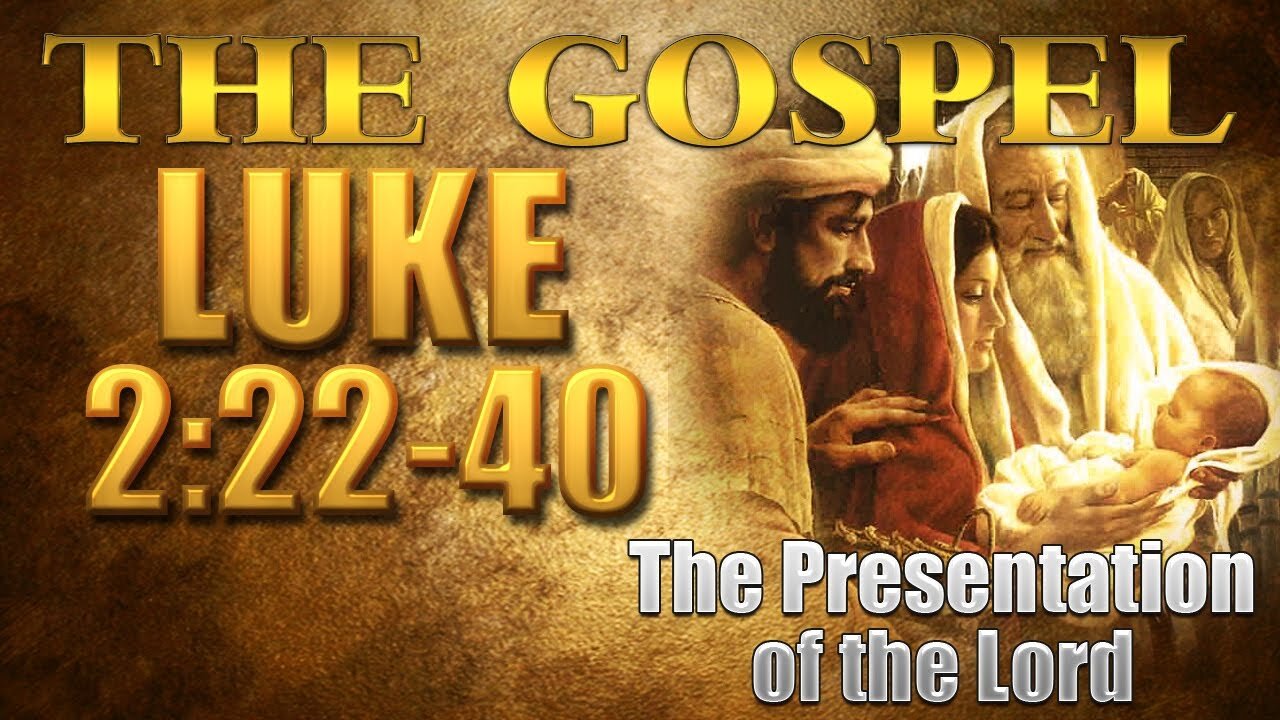
Presentation of the Lord

maxresdefault (1).jpg

Homily on “Lessons from Mary and Joseph, Simeon and Anna” on the Feast of The Presentation of the Lord (based on the Gospel of Luke 2:22-40) – Feb. 2, 2020

Today’s feast marks the Presentation of the Lord Jesus in the Temple, forty days after he was born. As the first born, according to the Law, Mary and Joseph were required to take Jesus to the Temple and “redeem” him by paying what was required by the law. At the same time, the Law required the child’s mother to offer sacrifice in order to overcome the ritual impurity brought about by childbirth.

Jesus, the Son of God, is already consecrated to the Lord. Mary, who is all-pure, immaculately conceived, still presented herself to be purified. Such is the humility of our God. Such is the humility of the Blessed Mother Mary. They submitted to the law even though they were not bound by it.

The Presentation of the Lord concludes the celebration of the Nativity – the Incarnation of God – God becoming one of us in the flesh - and with the offerings of the Virgin Mother and the prophecy of Simeon, the events now point towards Easter.

Simeon called Jesus the Light of the Nations, 'the light to enlighten the nations' including the Gentiles and so the image of Christ as the Light has led to the celebration of light countering darkness, and that is why we have the blessing of candles on this day. This day is also called Candlemas.

In the Eastern Church, this feast was called the Feast of the Encounter – meaning, this is the first encounter of the Old Testament, represented by Simeon and Anna and the Temple, with the New Testament, represented by the Lord.  Jesus is presented in the Temple following the ancient Jewish laws.  In the New Law of the Kingdom of God, Jesus' own body would become the New Temple.

When we were baptized in Christ – we received the light of Christ – and therefore we are also called to be the Light of the World… to be other Christs in the world.  At our baptism, we were also presented to God because we belong to God. 

At baptism, we also presented our children to God. The children that we have are not really ours.  They are given to us, in trust, for a time, a short time and we are asked to be mothers and fathers, mentors, guardians, protectors, teachers and friends to them but they are never really our children.  They belong to God.  If we understand this, we will be less inclined to act as owners of our children, to manipulate our children for our own needs.

In the image of Joseph and Mary presenting Jesus in the Temple, we have a wonderful model of husband and wife united in practicing the faith and in raising their child in the faith.

A scholar was conducting a study of an Amish village. The Amish live in traditional rural villages far from industrialization and technology: no computers, televisions, refrigerators and telephones. In his study of the Amish village school, the researcher noticed that Amish children never screamed or yelled. That surprised him. So he decided to check it out with the schoolteacher. He told the teacher that he had not once heard an Amish child yell, and asked him why that was so. The teacher replied, “Well, have you ever heard an Amish parent yell?” Meaning – it is clear: Like the parents, so the children!

As parents, we have the duty and privilege of raising our children in such a way that they grow up to become good and responsible citizens as well as committed children of God.

The example of Joseph and Mary, and the example of the Amish community, show us that the best way to achieve this is not just by talking and shouting at our children but by leading the way and showing them by the example of our own lives.

Our life is not just for ourselves. We are called to be a gift for others, a gift that leads them to God. This is the greatest thing about our life: We are called to give life. We are called to participate in the fruitfulness of God. We give life by enlightening others. We help other people come to the light by starting with ourselves by trying sincerely to be united with the One Who is the Light and by not fearing to show people the truth. The light shed by our lives produces a real effect in souls.

The question to us is this: Can we become more aware that we are in God’s presence now, that we too are God’s servants, and that we too are part of this story of salvation?

Every time we gather for our Eucharistic celebration here in the church, like Simeon and Ana in the temple, the House of God, we encounter Christ, and we recognize Him in the breaking of the bread, our Bread of Life.

… and very important to realize - we encounter one another. We are a blessing to one another. Do we see each other as a blessing to one another.

The meeting between Joseph, Mary and Simeon and Anna – is a blessing to both generations.  Just like our gathering now here in our Eucharistic celebration….

 – look around – various generations – the young and the elders – from different cultures …

- The Youth are graced by the wisdom of the living faith of the older generations and the elders are graced by the trust and promise of the youth.

Each one of us…. All of us….who gather here in the church for our Eucharistic celebration are a blessing to one another… because we are all beloved sons and daughters of God, brothers and sisters in Christ, co-heirs with Christ of the kingdom of God.

There is a story told of a rabbi in ancient times who gathered his students together very early one morning, while it was still dark. He put this question to them: "How can you tell when night has ended and the day has begun?"

 One student made a suggestion: "Could it be when you can see an animal from a distance and you can tell whether it is a sheep or a goat?"

 "No, that's not it," answered the rabbi.

 Another student said: "Could it be when you look at a tree in the distance and you can tell whether it is a fig tree or a peach tree?"

 Again the rabbi answered: "No."

 After a few more guesses the students said: "Well, how do you tell when night has ended and the day has begun?"

 The rabbi answered: "It is when you look on the face of any man or woman and you see them as your brother or sister. If you cannot do this, then, no matter what time it is under the sun, it is still night."

Now, turn to the people around you and look at each other’s faces.  What do you see?

Is it still night?

… or has the day begun?

Solemnity of Epiphany of the Lord

Epiphany_6January.jpg

Homily for the Solemnity of Epiphany of the Lord based on the Gospel of Matthew 2:1-12 - January 5, 2020

 First of all, the Feast of the Epiphany of the Lord is NOT the Feast of the Three Kings. They were not even kings; they were wise men.

Epiphany means manifestation. What the Church celebrates today is God’s revelation of Himself to the whole world, not only to the “Chosen People” but also to the Gentiles, us… a revelation that changes our hearts. Our Gospel reading tells the story of a group of men searching for Christ.  You see - their story is our story.  Their search is our search.

 All people – believers and non-believers are searching – And - What are we seeking?  What is at the heart of our longing? We all want happiness – We all want a sense of personal fulfillment. And - we all would like to believe that there is a real meaning in life.  We search for truth.

 And for us Christians, we search for or we long for – Christ - because we believe that Christ is the Way, the Truth and the Life who can satisfy our deepest longing.  We believe that Christ is the key to fullness of life, to meaning of life, to sense of fulfillment, to true happiness. Christ is the Light of the world, the Wisdom of God, the beginning of New Life and so we search for Him.

 But the problem is – we really quite do not know how and where to look for Christ…or maybe we even do not know what we are looking for.  Would we recognize Jesus when we meet or see Him?

 As I have shared a few weeks ago, one author wrote why the people of Jesus’ time missed Him or did not recognize Him as the Messiah because:

They were looking for A Lion, He came as a Lamb.

They were looking for a Warrior, He came as a Peace maker.

They were looking for a King, He came as a Servant.

 They were looking for someone to liberate them from Rome, He submitted to the Roman cross.

They were looking for someone to meet their temporal needs.  He came to meet their eternal needs….

 And so – there He was - standing right in front of them – they did not recognize Him – they even crucified Him… they killed him… and people continue to kill God in our age.

 We hear people say that they have already found the Lord… that they have found the truth – and yet - they are uncharitable and intolerant or impatient of those who have not had an experience similar to their experience or who do not share their particular prayer or spiritual life… which shows they are not behaving like true Christians. So, we can say that they have not really found the Lord, but they probably have only a vague notion of the Lord.

 You see - the only people Jesus was so critical of and had a problem with - were those people who thought they were better, holier than others.  

If we are intolerant of others, then others will not experience God’s presence in us. 

 Most of the people who say that they have personal relationship with Christ –  have in fact had an experience of God's presence - in their experience of God’s love for them personally…  But – we can say also that they have experienced only one or few of the many ways that God is present – and their mistake lies in the assumption that their experience of God's presence is the sum totality of God’s presence and reality.  They think that that is it.

 God is present in an infinite variety of ways in our lives and in our world.  If we focus only on one way that God is present, such as personal experience – with warm and fuzzy feelings and high emotions - we might miss many other ways God is present. 

 A retreat experience, the birth of a child, the love of a friendship or love in  marriage, even in a traumatic situation you have survived, living as a single  parent, dealing with physical challenges and sickness - all of these are additional ways we can find the Lord.   We can find Jesus even through those people who are very different from us… even through those we do not even like – and even in situations or places we would rather not go. 

 No one can claim that - he has God figured out – that he has discovered all of Christ and everything that Jesus can mean in his life.  No matter how strong we may be in our faith, there must always be some area of our lives where we are still searching for Christ.

 During the days of His public ministry, Jesus could be found in all sorts of places – sometimes in the temple, sometimes in the synagogue, sometimes at parties and banquets.  But the place where Jesus could most often be found was with people who needed him.  Some of them were sick, some were hungry, some were sad, some were lost or so deep in sin.

 Jesus said: “I came not to be served but to serve…” and so Jesus had a deep commitment to be with people who needed him.  That is where he most often could be found.

That – still - might be the most logical place for us to search for him today.

 Let me tell you a true story about a church – located in one of the poorest sections of Los Angeles.  On one Sunday of Advent, the pastor preached a sermon about the strange way we celebrate Christmas.  We call it the birthday of Jesus, but we exchange gifts among ourselves. So, he suggested that it would be far more appropriate if they would give something to Jesus on his birthday. 

 But he conceded that this would be difficult to do, since no one knew Jesus’ address.  He ended his sermon by telling the people that he had learned where Jesus lives.  And if they would come back the following week, he would give them the Lord’s address so they could present their gifts to him.

 The next Sunday, the church was packed, and the pastor stood in the pulpit with a stack of more than one thousand cards.  Each contained the name and address of a needy family.  Some of them needed food; some needed clothes, some needed shelter.  All of them needed something.  One by one he distributed the cards to the people.  And then he said:  “Now - you know - where Jesus lives.  This year you can give a birthday present to him.”

My brothers and sisters - Like the Magi, all of us are searching for Christ. 

 Where can we find Christ?  The most logical place to look is among the people who need Christ most.

Feast of Holy Family

Holy Family.  These two words – Holy and Family – unfortunately are scorned in our society today.  When people hear the word Holy - people think - too traditional – too serious – such a kill joy to be holy…

Feast of Holy Family (based on the Gospel of Matthew 2:13-15, 19-23)

December 29, 2019

Holy Family.  These two words – Holy and Family – unfortunately are scorned in our society today.  When people hear the word Holy - people think - too traditional – too serious – such a kill joy to be holy… and it is so unfortunate because people do not realize that true lasting joy and happiness, fullness of life can be found in a holy life, God-centered life.

The word Family – this word is being re-defined now in our society and it now means all kinds of living arrangements or non-traditional families people get into…  anything goes… nowadays.  Families have been and continue to be greatly challenged and threatened from all fronts.  

And yet - we still cannot deny that families are a treasure all of us must value and protect and it is a great challenge for all of us to nurture this treasure that God has given us… our family as a gift from God.

The heart of our parish is not this church. The heart of the universal church is not the Vatican. The heart of the church is the family… the domestic church -  the foundation and hope of our society. 

Pope Francis and Cardinal Luis Tagle both mentioned that we should pay attention to our youth, the young people.

And the family is still the single most significant influence to the youth. The quality of our youth reflects to us the state and quality of society. The state of the youth reflects to us what is happening in the family.

That is why it is so disburbing to hear and watch in the news cases of teen suicides and crimes being committed by the youth.

So - The question to us is this: How is our own family doing?

This last Sunday of the calendar year is a wonderful time to celebrate the feast of the Holy Family…an ideal time to ask ourselves: how is my own family doing?  Is there peace at our homes? Is there Love? Is there forgiveness? Do we place God above all? 

Let us ask ourselves, what needs to be changed and what more can we do to make our family not only better but holier? Do the members of our families see in each other – a gift from God?

In our modern secular – even atheistic society, people have some ideas of what makes families well adjusted, psychologically balanced, healthy, happy families:

  • Such as good communications, mutual respect, right balance of authority and obedience; parents know when to let go of their children timely and appropriately, etc. –  

 Admittedly - they are practical - helpful - good advise – to be a happier functional family – even non-believers subscribe to these principles or “common sense” values… But - the question is – are those enough to make us a Holy Family?...  as God meant for us… so that we will be truly blessed.

The atheists – they say: “goodness without God is good enough…so, be good for goodness sake.”  We even hear that phrase as part of a popular Christmas song…. Well, in truth, that is not good enough – because it must be – “Be good for God’s sake”, for the love of God… 

Even among the religious, church goers, the faithful – we often hear family members – for example -saying:  I am OK compared to that guy …I am not such a bad parent compared to others… so – I am OK -  or my family is OK compared to that family….

Comparing our families with other families - is NOT JUST, it is NOT WISE –

Yet, many of us think or say this.  "I wish my children were like theirs.  I wish my husband was like her husband or I wish my wife was like his wife.  I wish my parents were like my friend’s parents. " And so we use others as our standard.

That is wrong - because every family is a unique relationship of unique individuals, and every family has challenges which neighbors usually do not see.  In fact, we really do not know everything that happens inside other people’s homes – once they close their doors. So, we really cannot judge whether a family is good or bad.

If we really want to compare ourselves as individuals and as a family – let us look at the Holy Family of Jesus, Mary and Joseph.

Of course, people will quickly argue, “Jesus is God, Mary was immaculately conceived, and Joseph had to be a saint to be able to deal with everything that happened. How can we possibly be like them?”

We forget that the three of them, including Jesus, were just as human as we are – fully human. Theirs was a real family who experienced many of the same challenges each of us experience. At the beginning of their family life, there was talk of divorce when Joseph found out that Mary was pregnant even before they lived together. You can just imagine the confusion and dilemma Joseph must have experienced feeling betrayed.  Joseph must have felt terrible when he had to bring his wife to a stable to give birth to their child, and then used the feeding box for animals to lay the baby.  

After Jesus’ birth, as we heard in the Gospel, they had to escape from Herod’s murderous intention, so they lived in a foreign country, Egypt, away from their families and friends.

When Jesus was twelve, His parents searched for Him everywhere for three days.  You see, just like any family – they had their share of struggles and occasional tensions and misunderstandings.

 Mary found herself at the foot of the cross of her young son, brutally tortured and crucified.

Still, the Holy Family made it through the difficulties of their family life – How? - They had great faith and obedience to God’s will.  Joseph – in obedience to God took Mary as his wife even after he found out that Mary was already pregnant.  Joseph had faith that God would help him protect the child and Mary – and so, as instructed - he moved his family to Egypt. 

Mary – in faith – said yes to God’s plan even without understanding, without knowing what the future holds.  Jesus, obedient to God the Father - emptied Himself of His divinity, became one of us and He had faith that God the Father is working through His parents to care for Him and so He was obedient to Mary and Joseph. 

So, what makes them holy?  Jesus, Mary and Joseph loved each other – out of obedience to God the Father, out of love for God… rooted in their own personal trusting relationship with God the Father.  Each of them trusted the Heavenly Father.  They placed their love for each other – for their neighbors – within the wider, broader and deeper context and framework of their love for God the Father… … not just for goodness’ sake… but for the love of God.

Holy families do not just happen. They are something we all consciously create every day – that every member of the family create and make constant effort – every day - by working together and persevering – even - in tough times.

Admittedly, within our families we experience the heights of joy and also the depths of pain…God is present in the love, acceptance and forgiveness we offer our loved ones.

Our world desperately needs holy families; well-formed families whose children can grow and go on to form new well-formed holy families…

Often, it is the example of Christian families that attract others to faith.   Like the Holy Family, our families have a mission.  Blessings come with a mission. We are called to be a blessing to others, to promote God’s message of love, grace and mercy in the world through our examples and our actions as parents, as husbands and wives, as sons and daughters,

The Gospel was born into the family.  The Word became flesh in the family; and through our families, let the Gospel be proclaimed.

May all our families be holy.

Grace-filled Holy New Year to Everyone!!!

Stay Awake, Keep Alert, Be on Guard”

Stay Awake, Keep Alert, Be on Guard”

Homily on “Stay Awake, Keep Alert, Be on Guard” based on the Gospel of Matthew 24:37-44 and Letter to the Romans 13:11-14:

In Jesus’ time, the problem Jesus faced was NOT that no one was waiting for the Messiah; NOT that NO one was looking for a savior, but the problem was that Jesus turned out to be a different Messiah from what the people were waiting for.

Similarly – our own concepts of what or who God is could be our own obstacle to knowing and encountering God. We could be blinded by our own concepts and prejudiced ideas of what God is – of Who Jesus is; of how God would come into our lives. The truth of the matter is that people did not recognize Jesus then and they do not recognize Him now.  Just as John the Baptist declared: “There is one among you whom you do not recognize (Jn 1:26). 

31st Sunday in Ordinary Time: Every Saint Has a Past, and Every Sinner Has a Future...

31st Sunday in Ordinary Time: Every Saint Has a Past, and Every Sinner Has a Future...

I asked a seminarian as to what or who inspired him. He said: “If the saints can do it, we can do it.

How grateful we are for the saints. Their courage and example inspire and encourage us. Actually - We are all called to be saints because only saints can enter heaven. Many of us, even the best of us, will not go straight to heaven, but will have to spend time in purgatory, so to speak, to purify us from the consequences of our sins and from our sinful inclinations before we enter heaven.

That is why – aim high - aim to be saints – aim for heaven. If you miss – you will end up in Purgatory but if you live your lives aiming minimally only for Purgatory, if you fall short – well, you know what that could mean…

Mission- More Work, More Grace

Mission- More Work, More Grace

Today is World Mission Sunday - a day set aside for Catholics worldwide to revive our missionary awareness and commitment…a day to reflect on how to pass on the faith.

We recommit ourselves to our common vocation, by virtue of our Baptism, to be missionaries, through prayer, participation in the Eucharist, and by providing financial support and concrete help to all the missions of the world".

Today we share in those celebrations taking place in every parish, seminary, school and convent all over the world.

In the Gospel - Jesus told His disciples and is telling us about the necessity to pray always and not lose heart.”

Let us pray especially for Missionaries for perseverance and for them not to lose heart.

St. Francis Xavier, S.J. , along with St. Therese of Lisieux, the Little Flower - are the patron saints of missionaries. Let us ask for their intercessions for missionaries and all missionary works.

Talking about missionaries - Our Pastor Father Glenn actually is a missionary belonging to the Mission Society of the Philippines… Actually, he was in Korea for at least15 years and spent some time in Bangladesh; and so, let us pray for Fr. Glenn and provide him all the support we can in any way and let us pray for all MSP missionaries.

Please always include Father Glenn in your prayers. Let us also pray hard that God will send a parochial vicar to our parish as soon as possible so Father Glenn can find time to rest. Every now and then we check on Father Glenn because we are concerned about him and, being a true missionary, he said: “More work, more grace.” Inspiring! There is so much truth in that.

The will of God will not take us to where His grace cannot sustain us.

The more we share our faith, the stronger our faith becomes.

The Mission Society of the Philippines (or MSP) was established by the Catholic Bishops' Conference of the Philippines (CBCP), and so the MSP serves as the official and chief missionary arm of the Catholic Church of the Philippines… as a gift to the world in gratitude for the faith and blessings brought to the Philippines also by missionaries.

The MSP now has been working in five continents and at least twelve countries in the world including the United States and that is why Father Glenn is here and we are so blessed.

One of the many missionary visions or goals of MSP is to instill missionary consciousness to the Filipino migrants, making them partners and instruments of missionary vocation.

And so – let us use ourselves as an example. We - who are migrants here in America – we are here not just to enjoy ourselves with the comforts and pleasures and material prosperity – we have a mission - there is a reason why we are here… in fact – we have a mission wherever we find ourselves in.

We are all so blessed…. And our Blessings come with a mission.

Pope Francis, a Jesuit priest, a missionary himself said: “I am a mission, always; you are a mission, always; every baptized man and woman is a mission.”

St. Teresa of Calcutta said and it is still true today: “There are many in the world who are dying for a piece of bread but there are many more dying for a little love. Being unwanted, unloved, uncared for, forgotten by everybody, I think that is a much greater hunger, a much greater poverty than the person who has nothing to eat.

She said: “The greatest disease in the West today is not physical illness or disease; it is being unwanted, unloved, and uncared for. We can cure physical diseases with medicine, but the only cure for loneliness, despair, and hopelessness is love.

The poverty in the West is a different kind of poverty -- it is not only a poverty of loneliness but also of spirituality. There's a hunger for love, as there is a hunger for God.”

Therefore – we should see the West – America for example – as our mission field. We live in a very secular and even atheistic society to say the least.

Pope Emeritus Benedict XVI said: “The world offers you comfort, but you were not made for comfort; you were made for greatness.” - meaning – we were made for holiness… set apart for God. We are in this world – but not of it.

We always have to remember as the Scripture says: Much more has been given to you – much more is expected of you. And we need to share this vision and mission to our children who are born and raised here for them to continue the mission… and so we need start in our own families. We need to tell our children our faith stories.

Those of us who made it here in America – we are not only so materially blessed in so many ways – we also have the freedom – including freedom to practice our faith unlike in many areas in the world. In fact, there is too much of everything here in our society – materially and in terms of freedom – anything goes pretty much including morally - that people lose sight of what really matters in life and that is the danger for all of us.

If we are not careful – we who migrated here, we initially might have been materially poor but spiritually rich when we left our country but because of attractions and attachments to material things and comfort and pleasure and new found freedom – we might be finding ourselves now – materially rich but spiritually poor… and worse even – there are those – both financially poor and spiritually poor.

For many of us who are first generation immigrants – coming from a Third World Country like the Philippines - We know what it is like to be without – we know how to persevere and not lose heart and not lose hope even in the midst of struggles and pains - that is a gift we need to share with those who were born with a silver spoon – so to speak - who do not know how to deal with sufferings and struggles in life.

Reality check - Life is getting tougher and tougher even here in America – illness due to too much pleasure and too much consumption of all kinds; violence, financial problems, degradation in moral values, etc.

Many people around us do not know how to deal with struggles – their threshold for pain is so low and so they are the ones who give up on life so easily because they do not know any better.

And so – as Christians – we are called to be light of the world, the salt of the earth and source and instruments of hope.

Only in Christ, can humanity find hope. (St. Pope JPII)

"The Lord always reminds us how precious we are in His eyes, and He entrusts us with a mission." (Pope Francis)

St. Teresa of Avila said it so beautifully: Christ has no body now on earth but yours. Yours are the feet with which he walks to do good; Yours are the eyes with which He looks with compassion on this world; Yours are the hands with which He blesses all the world. Christ has no body now on earth but yours.

We say in our Profession of Faith: We believe in one, holy catholic and apostolic church. We are the apostolic church. The word “Apostle” means “one who is sent to deliver or proclaim the teachings to others.

That is why at the end of the Mass… after having been nourished by God’s word, His Body and Blood, we are sent to go out there into the world in the peace of Christ, to glorify the Lord by our very lives…. By proclaiming the Good News of God’s love, grace and mercy in Christ by our very lives.

Actually, in essence, the mass never ends. It must be lived.

God bless…

29th SUNDAY IN ORDINARY TIME – CYCLE C

OCTOBER 20, 2019 - Luke 18:1-8

Living by Faith

Live by faith.jpg

Homily on “Living By Faith” (based on the Reading from the book of the Prophet Habakkuk 1:2-3; 2:2-4 and the Gospel of Luke 17:5-10):

 Today’s first reading comes from the Prophet Habakkuk.  Habakkuk lived around 650 years before the Lord.  It was a time of violence.  The Babylonians were threatening or attacking the rest of the world, including the kingdom of Judah.  Hatred and violence were seen as part of life, and so the prophet Habakkuk cried out for help and deliverance.

 The history of our faith is filled with stories of deliverance.

 The most popular of all is the Exodus, the story of deliverance of the Israelites from slavery in Egypt to the Promised Land.  The Exodus has represented salvation and deliverance for people of faith.

 And there are many other stories - People delivered from fiery furnaces and lions’ dens, from giants, from devils, and from mighty armies; delivered from famines, floods, and terrible diseases, even from death. So, the people of faith understand God as a God who acts, who acts for our deliverance… as our Savior because we cannot save ourselves.

 We all have our own deliverance stories – from illness, strained relationships, financial struggles, violence, poverty, abuse, … and because of them, hopefully, they strengthened our faith in God.

 But – admittedly – our stories have not always been stories of deliverance.  What about those times when deliverance did not come? – when it seems our prayers were not answered?  Does that mean we did not have enough faith as those people we hear about who have survived through major tragedies and struggles in life?

 Let me share three points to ponder:

 First - When deliverance doesn’t come, it does not change who God is.

God is still God. God remains the same. Often, God’s methods or ways are not our ways – and are unknown to us.

God’s ways are simply a mystery. Sometimes we cannot know why things happen as they do - but this does not change who God is.  God remains our loving, gracious and merciful Father. He will always love us.

Secondly - When deliverance doesn’t come; when our prayers are not answered, it does not necessarily mean we are being punished.

It is possible that we are experiencing the consequences of irresponsible decisions. But all suffering is not punishment. As a matter of fact, both the scriptures and church history show us that the most godly people are often the ones who suffer most.

Think of all the good people, perhaps some of the finest Christians you yourself have known, for whom deliverance has not come. Think of our Lord in Gethsemane. Even for him there was not the kind of deliverance for which He prayed. We should not always complicate our experiences of suffering by adding guilt. When deliverance doesn’t come, again, it doesn’t necessarily mean we are being punished.


Thirdly - When deliverance doesn’t come, it does not mean there is no grace.


Sometimes deliverance and grace are not the same thing.  The deliverance  that God provides is not always the kind of deliverance we might choose for ourselves - but it is always the victory of grace… maybe not delivering from pains and struggles but overcoming them by the grace of God.  God promised that He will always be with us in our struggles in life.

 And the Good News is – if you really think about it, sometimes when deliverance has not come, we have ended up actually finding more grace, finding more of God, finding more of ourselves than we would have - if the deliverance we wanted had come – we could say it is a “blessing in disguise”, so to speak.

 God, in his infinite wisdom and permissive will, somehow allows us to suffer because He can bring good out of something seemingly bad.

The truest meaning of faith is the capacity to believe, even when no answer to our problem or even when no healing comes – in the way and time we want them.  True faith is trusting that God’s grace is sufficient, and will ultimately triumph over all things. As one popular song goes: “He makes all things beautiful in His time.”

 Listen again to the Old Testament prophet Habakkuk from our first reading:

How long, O LORD? I cry for help but you do not listen!
I cry out to you, "Violence!" but you do not intervene.
Why do you let me see ruin; why must I look at misery?
Destruction and violence are before me; there is strife, and clamorous discord.

Then the LORD answered me and said:
Write down the vision clearly upon the tablets, so that one can read it readily.
For the vision still has its time,
presses on to fulfillment, and will not disappoint;
if it delays, wait for it,
it will surely come, it will not be late.

 What is that vision?  The big picture - God’s vision of the world.  His plan is still unfolding.  God knows what He is doing with the universe.

 Let us pray for wisdom every day. Wisdom is seeing things and events, seeing ourselves and seeing other people, seeing our current circumstances and reality as God sees them. We need to pray for wisdom everyday.

 Let us put our faith in God’s love and mercy – even if it seems to be taking forever – let us not give up.

 So – if it delays – What are we supposed to do? WAIT!

 Admittedly - like Habakkuk, we lament and complain – we get impatient - How long O Lord?

 We can all relate and identify with that prayer and must have expressed it ourselves.  At times – we get to a point in our life – we get frustrated - we just do not know what to do anymore and we start to question why God does not do something.

 How long?  Listen to the answer:  “If it delays, wait for it, it will surely come, it will not be late.” -  in God’s time… in God’s good time, in God’s ways, in God’s plan which holds everything together.

 We all have our own problems of all kinds – losing a loved one, illness, financial problems, relationship problems, … and recognizing our own weaknesses, we come together today to pray for faith and for the courage to live our faith and for the grace to accept the complexities of life… that God works in ways we do not easily perceive or understand.

 Faith is confidence in the will and purpose of God which gives us the power to endure whatever may come.

 Let us pray that we continue to put our trust in God and in His Divine Providence.

 Like the apostles, we pray: “Lord, increase our faith.”

 So - If you think you have been given a difficult role in life, or if your faith leads you to face steep challenges, continue to give thanks to God.  He obviously has great plans for you and me.  God has given us the faith we will need.  Let us use that faith, and we will see God do what we could not do on our own.

 Like the servants in the Gospel, we continue to be faithful and we continue to serve God, do His will as He commanded … and that is all.  To God, and not to us, be the glory.  What greater joy could there be than that?

God bless…

Rich Man and Lazarus

images522B3VQY.jpg

Homily on Mercy, Love and Compassion (based on the Parable of the Rich Man and Lazarus; Luke 16: 19-31):


An angel appeared at a gathering and told the leader of the group that he had come to reward the leader for his years of devoted service. The leader was asked to choose one of three blessings: either infinite wealth/money, or infinite fame or infinite wisdom. Without hesitation, the leader asked for infinite wisdom. “You got it!” said the angel, and disappeared. All heads turned toward the leader, who sat glowing in the aura of wisdom. Finally one of his colleagues whispered, “Well, say something.” The leader looked at them and said, “I should have taken the money.”


“Money is not the root of all evil.  The love of money is the root of all evil.”


Last week’s Gospel ended with: “You cannot serve both God and mammon.”  In today’s Gospel, Jesus tells us what happens as a consequence of loving money, pleasures and comforts of this life more than loving God and our neighbor.


The rich man went to the netherworld not because he was rich.  No, it is because of his self-centered preoccupation with his own life and its pleasures.  He was so spiritually blinded that he could not, would not even give a little attention to the needs of a poor man lying at his doorstep.  That’s the reason he ended up in torment.  That’s something all of us need to ponder because there might be a poor man at our own doorsteps.


From hell - the Rich Man raised his eyes and saw Lazarus.  But you see – before - the Rich Man never saw Lazarus as a fellow human being. The Rich Man may have noticed Lazarus before but only as a stinky, beggar in dirty clothes begging for food.


In the Gospel we heard two Sundays ago, the Pharisees saw the people Jesus was eating with - only as tax collectors and sinners but God saw them as His children who had gotten lost and needed to be found. That’s the reason Jesus came, and that’s the reason he welcomed sinners and ate with them.  He was trying to help them find their way back to God.  This was something the Pharisees did not understand – the loving merciful heart of God – how He feels about His people…. about us….


When people hear the word “Mercy”, they often think only in terms of forgiveness… but mercy means also compassion, to “suffer with”, compassion particularly towards those who are in need in one form or another… all around us… even within our own family.


We say that God is compassionate, but we ignore the poor. We say that God loves us and has mercy on us, but we hold grudges against our relatives and friends. Our actions need to truly reflect God's mercy. 


The parable in today’s Gospel tells us to open our eyes and our hearts to be more aware of the people around us who need our help. That person, that Lazarus at our gates, might be the means for our own salvation.  The truth is - the poor people actually teach us how to love.


Certainly - many of us are living in a world that has provided well for our needs.  We are fed, sheltered, supported by family and friends.   There is really nothing wrong with all of these… We surely have a right to all of these.  The question to us is:  What are we doing for those to whom life has not been so kind? – What are we doing for the less fortunate?


Are we walking by the Lazaruses in our own community without seeing them as fellow human beings.


Are we quick to assume that the person begging at the street corner maybe a drug addict, or an alcoholic, perhaps a thief… or perhaps someone who is lazy or who has not worked hard enough?


Of course, we are not all called to be another Saint Teresa of Calcutta but her life of faith gives us a great example and insight into the heart of God.  


As St. Teresa of Calcutta shared – that at the heart of her vocation is to respond to Jesus’ words “I thirst” on the cross – Jesus’ longing for the love of the broken bodies of the poor and His desire to offer Himself as spiritual drink to the poor.  Jesus wants their love, and He wants to give Himself to them so that they would be free to give themselves back to Him… but the poor cannot - because they are hungry and suffering… They are more concerned about physically surviving.


The ultimate goal of our helping the poor – after providing them with their basic human needs – more importantly - is for the poor to also encounter and know Christ Who is the key to everything… With Christ, you have everything.


At the end of our lives, we are all going to be called to give an account for all that we have been given – either much or little.  We need to be always reminded and challenged with this verse from the Gospel of Luke, 12:48: “Much will be required of the person entrusted with much, and still more will be demanded of the person entrusted with more.” .. and we have all been given much more…


These words are frightening because they apply to us who live in the richest and most materialistic nation in the world.


What kind of sin the Rich Man ended up in Hell for? The sin of omission. We don't think about that, do we? Usually when we go to confession – if we go to Confession – that is another story - we say, "Father, I did this, I did that, I thought about this, I had too much of that,-- But again, the sin that sends the Rich Man to Hell, is actually his indifference to the poor… He is disconnected… He has no compassion…


It is not enough that you do not do bad things. The question is: Are you doing anything good for others who cannot pay you back?


My brothers and sisters -  Are we not the “rich man?”


This famous Gospel parable challenges us, it does not condemn us. It is meant to bother us, to disturb us, to get under our skin, so to speak. What are we doing in our lives to take care of the poor? 


Everyone of us here, when we stand before God on that day of judgment, will be judged on WHAT WE HAVE FAILED TO DO, not so much on what we have done. Sometimes we look at what we have done and say, "Oooh, look at what I have done or accomplished." When we focus on that, we forget what we have failed to do.


In Matthew’s Gospel:  Jesus said, "I assure you, as often as you neglected to do it to one of these least ones, you neglected to do it to Me.”

In the Gospel reading, the rich man cried: “but if someone from the dead goes to my brothers, so that he may warn them, they will repent.”


Maybe, if someone were to rise from the dead, we would change our priorities.  Maybe if someone were to rise from the dead we would be infinitely more concerned with the spiritual than we are with the physical.  Maybe if someone were to rise from the dead we would use our gifts, our talents, our intelligence, and our possessions to reach out to others in need. 


But you know what?  Someone has already risen from the dead.  He calls us to have faith in Him - instead of faith in our possessions. His name is Jesus – our brother.  Today, we plead with Him to help us be truly Christians and merciful.


God bless…


Cycle C – 26th Sunday of Ordinary Time

(Amos 6:1, 4-7; 1 Timothy 6: 11-16; Luke 16: 19-31)